
Published on 01/08/2026
Migrating your CMS to Storyblok, simplified by AI
Topics
- Insights
- Solutions
- Spin-offs

Why migrate at all?
Content management systems have a considerable influence on the efficiency of your teams and the performance of your online presence. They determine how much effort it takes to manage and amend existing content (see: 'content debt' video below), how quickly the editorial team can publish new content, whether costly developer resources are needed in day-to-day operation, and how reliably the website* performs under load. Well-structured, cleanly maintained content can also be read by AI systems far more easily than deeply nested HTML pages, which benefits GEO / LLMO rankings.
Alongside Contentstack, Magnolia, Contentful, TYPO3 and WordPress, one of the best-known enterprise CMS solutions is Adobe Experience Manager (AEM). It is used primarily by large corporations already deeply rooted in the Adobe world. Its range of functionality is extensive, but it has its weaknesses too: editors' dependence on developers and AEM specialists, high maintenance and running costs, and considerable complexity in day-to-day content management. A further complication arises when core support for Adobe Experience Manager 6.5 comes to an end. For customers on Adobe Managed Services, this happens on 31 August 2026; for on-premise installations, it is expected in February 2027. For many organisations, particularly those that have been struggling with AEM for some time, that is one more reason to look at alternatives. Storyblok is one of them.
* For readability, this article refers primarily to websites. CMS solutions such as Storyblok can of course also be used for apps, portals and the like.
Content debt: the silent risk
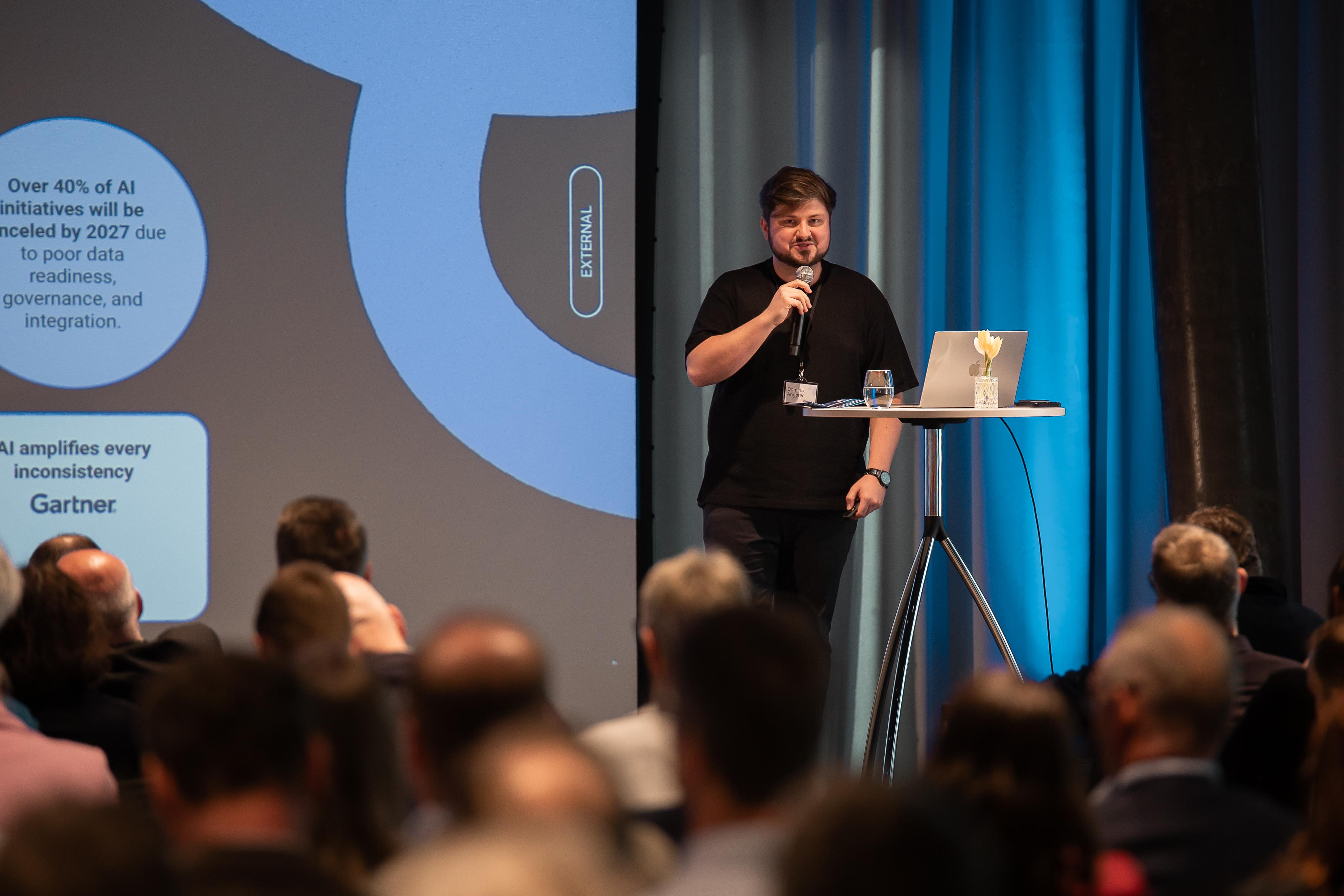
On 23 April 2026, the Netural AI Symposium took place in Upper Austria. Among the renowned speakers: Dominik Angerer, co-founder and CEO of Storyblok. He spoke about how AI is changing marketing and content management, and about the risk posed by content debt, that is, outdated content. Don't miss it.
Why Storyblok in particular?
Storyblok is a headless, API-first CMS. While in a traditional CMS, content and design are hard-wired together, they are separate in a headless CMS.
The content (text, images, product data) sits centrally in the CMS, where it is managed by the editorial team.
The design is defined through components, or building blocks. Each component (the hero, slider or text block, for example) has its own design and can be reused across any number of pages.
If design or functional changes are required, only the component needs to be amended and the design is updated automatically across the entire website. The front-end stack can be chosen by the developers themselves, whether Next.js, Nuxt, Astro, React, Vue, Symfony or Angular.
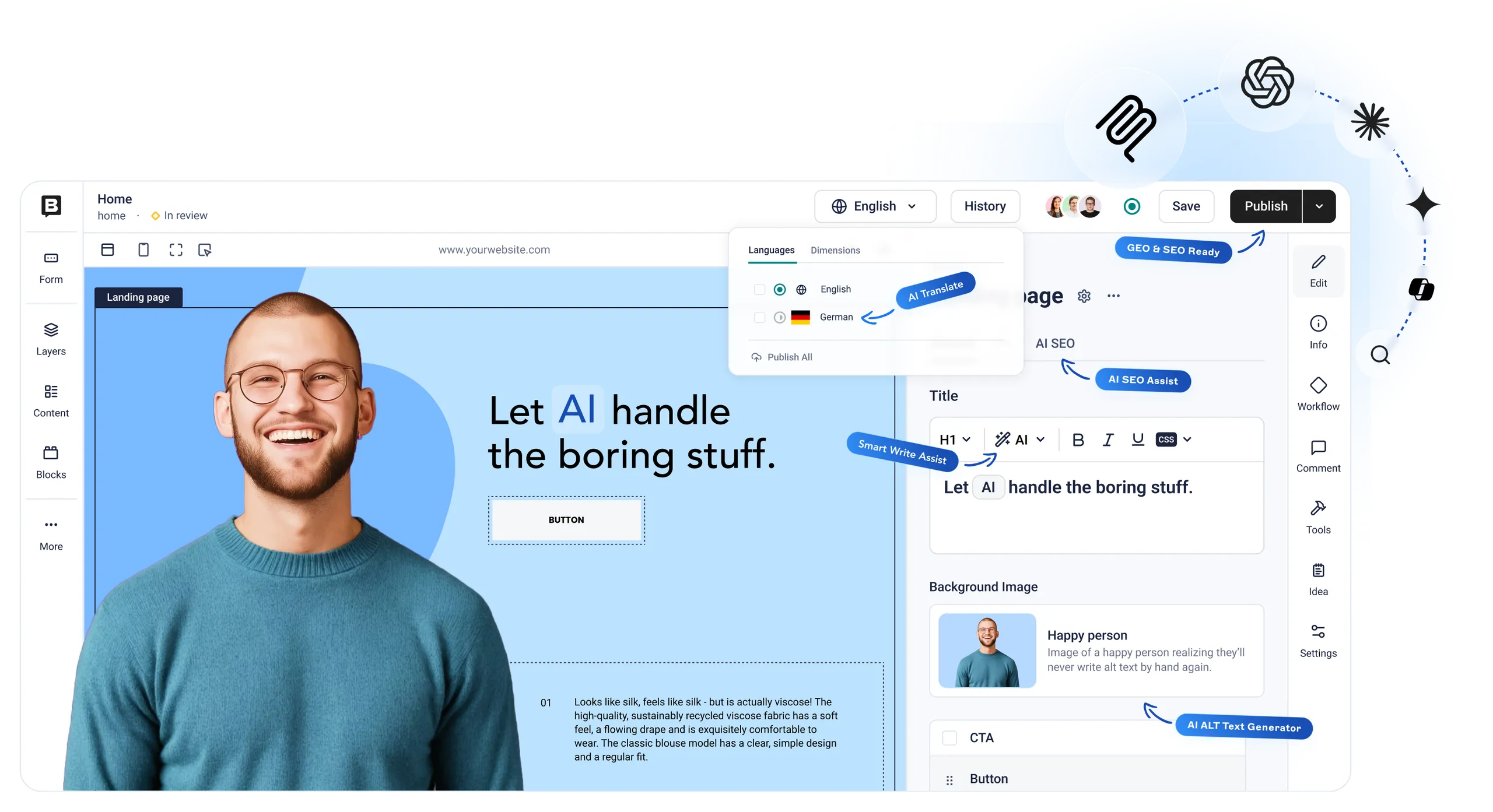
The website then pulls the content from the CMS via an interface (API) and displays it in line with the design specified. The editorial team concentrates solely on the content, not on how that content is presented. A visual editor gives them a preview of how the content they enter will appear on the website once published.
To ensure that each editorial team only has access to the content it actually looks after, custom roles (translator or manager, for instance) can be assigned alongside the standard roles of owner, admin and editor – right down to folder, language and asset level. The editorial team then creates, publishes and iterates entirely on its own, with no dependence on developer capacity.
Storyblok's further strengths include the integration of any third-party tool, a native MCP server that connects AI agents directly to the content, FlowMotion, which makes content creation easier (e.g. through auto translations, alt-text generation and publishing workflows), and a high level of security through ISO 27001 certification, approval mechanisms, audit trails and so on.
Here and here you can find a detailed comparison of AEM and Storyblok [links redirect to storyblok.com].

© Image Credits: Storyblok GmbH
What challenges does a migration bring?
CMS migrations usually pursue 5 goals: a fast migration, low internal effort, no website downtime, no data loss and no content freeze.
The problem? The demand for speed and the complexity of the migration are often at odds. With many clients, web content is not cleanly structured but rather has grown organically over the years. That makes it harder to identify the components required and to transfer them into the new CMS schema. There is also the question of how to ensure that no links break, that all images display correctly (including alt texts) and that search engine rankings do not suffer as a result of the migration. A complex undertaking.
It should also not be forgotten that the CMS migration often means a short-term increase in workload that the marketing or editorial team has to absorb – although they usually also have other operational and strategic duties to attend to in parallel. In short: resources are tight. What increases the complexity even further is that, in many cases, content production cannot simply be paused ("content freeze") for the duration of the migration either. The consequent release of new content during the ongoing migration can easily create a problematic gap between the existing site and the new website.
Thus the reality is that the 5 goals can rarely be pursued all at once. Anyone wanting zero data loss and uninterrupted operation generally pays for it with laborious, drawn-out processes. Anyone prioritising speed, on the other hand, cannot guarantee that problems of a technical or editorial nature will not arise.
How does Netural resolve this migration dilemma?
Our aim is to cover all 5 goals as fully as possible. That is why we rely on an AI-supported migration, with human oversight.
AI agents are used to build a pipeline: a program that reads the content out of the source CMS (AEM, for example) and transfers it into the new Storyblok schema. The migration itself runs entirely without AI. We deliberately avoid a prompt-based script, which would be prone to hallucination. Your copy, prices and product data therefore arrive exactly as they stand in the legacy system. Shop connections and app integrations likewise remain stable throughout the migration process.
To safeguard the quality of the migrated content, every migrated page also goes through an automated check: Has every component been transferred correctly? Do all redirects work? Does every image load? The process also picks up faults that were already lying dormant in the legacy system, such as image embeddings that had long returned error messages.
The results of this check, including all anomalies, are listed concisely in a report to simplify the approval process. The anomalies listed are reviewed by our project team and, if you wish, by your editorial team. Only once it has been signed off does the page go live. The result: high precision and speed, no data loss, and minimal effort or disruption.
 AI-generated image
Netural's approach: AI-supported CMS migration

© Image Credits: Bitpanda Academy
Bitpanda
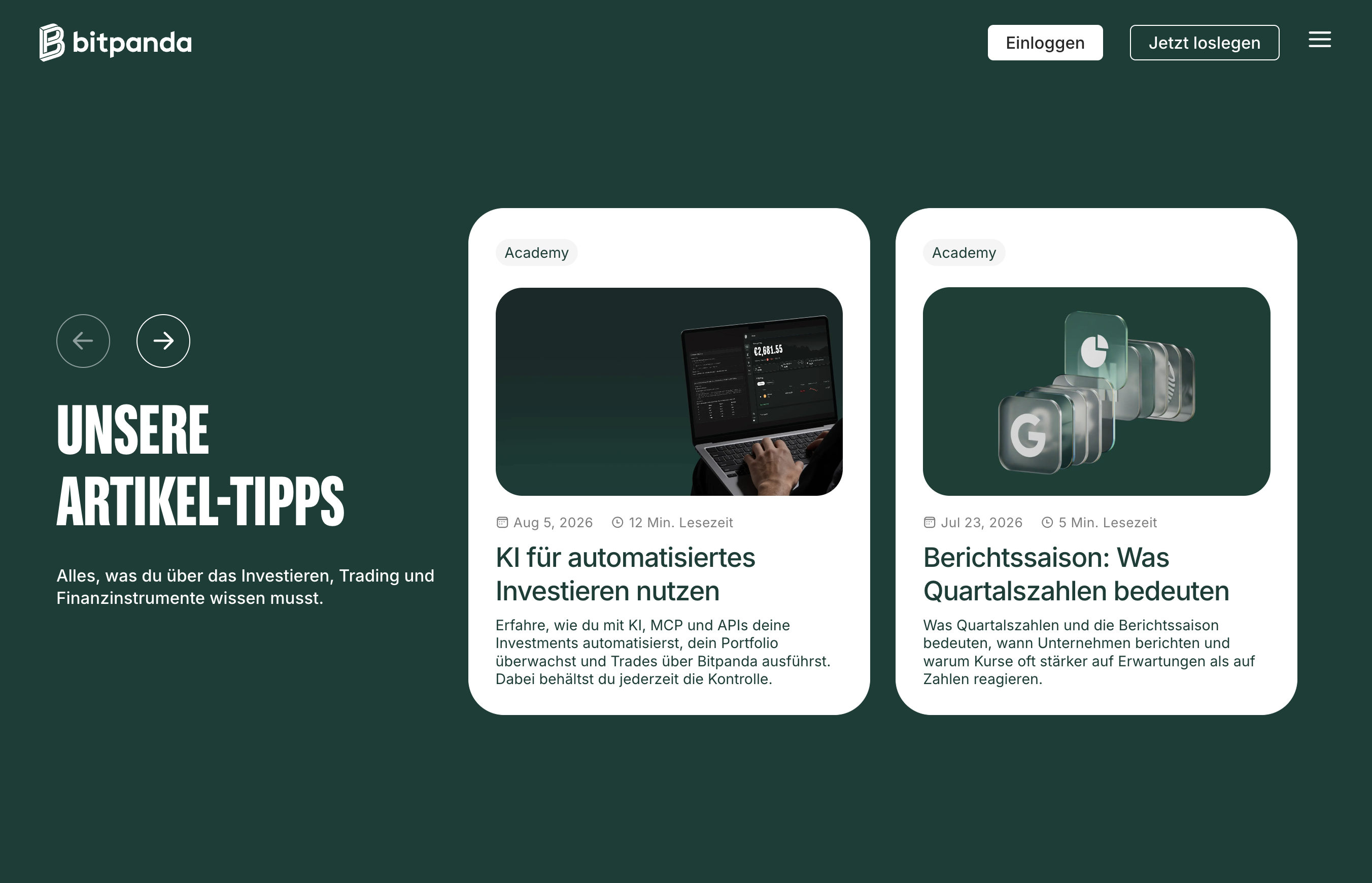
Together with our partner David Moling, we migrated the Bitpanda Academy from Twill to Storyblok within three months: 1,065 pages, 275 articles in five languages, plus 1,038 automatically generated redirects so that no search engine ranking and no shared link was lost. The Academy continued to run unchanged throughout the migration, so users were not affected.
Conclusion
Changing your CMS is a demanding project, carries great risk and should be thought through carefully. But the cost of a system that no longer suits your team should not be underestimated either. The same goes for licences covering functionality your team never uses. Migrating to a new and better CMS is an investment in the performance of your editorial team and your web presence. Storyblok is not only a CMS alternative with future-proof, user-friendly functionality, it is also ideally suited for our AI-supported – and therefore faster – migration process.
Frequently asked questions
How long does a migration from AEM to Storyblok take?
The pipeline for your source CMS can be built in a matter of days. The migration itself depends heavily on the number of pages, the variety of components and the quality of the existing data. For approx. 1,000 pages in five languages, expect roughly two to three months.
Does content creation have to pause during the migration?
No. Because the migration runs step by step, in batches, the editorial team can carry on working in areas that have already been migrated while other parts of the website are still being migrated.
Does Storyblok allow us to manage several websites in parallel?
Yes. A multi-space/multi-site architecture allows several domains to be run with shared components but separate editorial teams and permissions.
Which front-end technology do you use?
Depending on the project, React/Next.js or Vue/Nuxt. The choice depends on the existing tech stack, the client's own skills and the requirements for rendering (SSR), performance and component reusability.
How are test and production environments organised?
Two test environments are standard, one for minor adjustments and one for larger development work, maintained as exact copies of the production environment and synchronised automatically at regular intervals.
How is data protection handled in Storyblok?
Personal user data, from forms, for example, is not stored in the CMS but passed directly to downstream systems such as the CRM. A deletion policy should be put in place for editorial user accounts.